
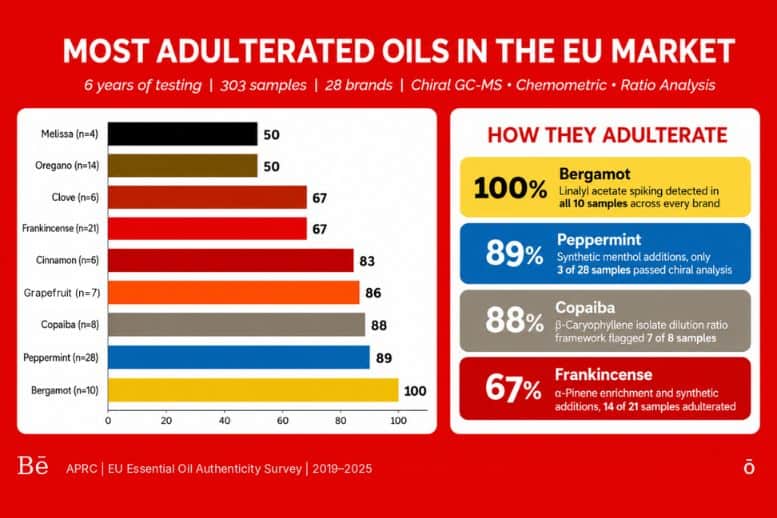
Do You Really Know What’s in the Bottle? According to a slide presented as APRC material during a dōTERRA event, 303 samples from 28 brands were tested in the European Union between 2019 and 2025. Among the most problematic essential oils identified were bergamot, peppermint, copaiba, grapefruit, and cinnamon.
An important caveat: these percentages apply only to the specific set of samples that was tested and should not be interpreted as the official prevalence across the entire EU market. However, as a warning signal, the findings are significant and align well with peer-reviewed research showing that some essential oils sold to consumers may be diluted, reconstructed, or chemically "adjusted".
Do you really know what’s in the bottle?
A label can say almost anything: “100% pure,” “natural essential oil,” “aromatherapy grade,” “premium.” The problem is that the market does not reward quality alone. It also rewards the ability to create a product that smells convincing and fits customer expectations.
And that does not always mean the bottle contains an authentic, unaltered essential oil from one plant, one batch, with full source traceability.
In one study of essential oils purchased online, more than 45% of samples failed to meet the relevant standards, and over 19% were diluted with substances such as glycols, triethyl citrate, or vegetable oil. EDQM guidelines also emphasize that the quality of both the essential oil and the starting plant material matters not only for scent, but also for user safety.
What the APRC signal revealed about the EU market
On the APRC slide widely circulating in convention materials from the 2026 Convention in Katowice, the numbers stand out sharply: bergamot showed signs of adulteration in 100% of samples, peppermint in 89%, copaiba in 88%, grapefruit in 86%, cinnamon in 83%, frankincense in 67%, clove in 67%, oregano in 50%, and Melissa in 50%.
These figures sound shocking because they challenge a common myth: “If an essential oil were fake, you would smell it right away”.
Not always.
Older research on bergamot has already shown that an essential oil can be reconstructed to smell highly convincing, while the difference only becomes visible in the enantiomeric “fingerprint” of compounds such as linalool and linalyl acetate.
In other words: your nose may accept what a laboratory should not.
What adulteration looks like in practice
The simplest model is dilution: adding a carrier oil, a cheaper essential oil, or a fraction from another raw material.
A more sophisticated model is “adjusting” the scent profile with individual compounds or isolates. For bergamot, APRC describes the addition of linalool and linalyl acetate, or building a base from cheaper citrus oils. For peppermint, it mentions adding synthetic menthol for a stronger, more “minty” effect. For frankincense, enrichment with α-pinene. For Melissa, boosting the profile with citral from lemongrass, litsea cubeba, or lemon myrtle, as well as adding β-caryophyllene from other sources 😡
In the case of copaiba, the public APRC slide refers to the issue of a “β-caryophyllene isolate dilution ratio.” The scientific literature on copaiba also confirms that authenticity must be assessed through the full profile and the relationships between sesquiterpenes and diterpenes, because an attractive level of a single marker alone does not prove anything.
Why it matters for aroma, safety, and marketing
First, aroma. Some additives are specifically intended to make an essential oil smell “more like it should” - cooler, more citrusy, fresher, or simply more “premium.”
Second, safety. An article published in the Polish journal Medycyna Pracy notes that GC-MS analysis can detect not only the major but also trace components of essential oils, including potentially allergenic compounds such as linalool, eugenol, and geraniol. Information about the presence of these substances should be clearly communicated by the manufacturer.
These ingredients are not bad - usually are good! But people with allergies should know about them, because for them, they can be bad.
Third, marketing. Claims such as “natural,” “aromatherapy grade,” or even compliance with selected standard parameters are not substitutes for a Certificate of Analysis (COA), a batch number, supplier traceability, and comprehensive authenticity testing.
This is becoming increasingly important from a regulatory standpoint as well. In the European Union, labeling requirements for fragrance allergens have been expanded specifically to provide better protection for individuals with allergies and sensitivities.
Why standard GC-MS is not always enough
GC-MS is the foundation of quality control, and without it, there can be no serious discussion about essential oils. The problem is that conventional GC-MS primarily reveals composition and relative proportions - it does not answer every question.
If a synthetic or reconstructed component has the “correct” molecular mass and a matching profile, the sample may appear entirely convincing. Chiral GC goes a step further by distinguishing between enantiomers, whose ratios are often characteristic of a substance’s natural origin. This is why the scientific literature describes chiral analysis as a valuable tool for assessing the authenticity of peppermint, citrus, and conifer essential oils.
GC-C-IRMS (gas chromatography coupled with isotope ratio mass spectrometry) takes the analysis even further by detecting more sophisticated forms of adulteration. In studies of bergamot oil, it has been used not only to identify the presence of adulterants but also to distinguish their nature and origin.
APRC also points out that short GC-MS runs may fail to detect some heavier, less volatile adulterants. As a result, both the duration of the analysis and the design of the analytical method can have a meaningful impact on the reliability of the results.
How to Buy Essential Oils Wisely
If you're choosing an essential oil for yourself or for use with clients, don't just ask, “Does it smell nice?” Ask, “Can I trace this specific batch?”
Look for the full botanical name, country of origin, plant part used, extraction method, batch number, and a current Certificate of Analysis (COA). Request a GC-MS report for the specific batch, and for more expensive or commonly adulterated oils, also ask whether the supplier (as companies like dōTERRA do - you can read in Source To You) performs chiral GC and - when necessary - IRMS testing.
Check whether the producer provides traceability, not just marketing slogans.
For massage, it is always worth considering a small-area skin test during the first session, while remembering that this does not replace dermatological patch testing, which remains the diagnostic standard for contact allergies.
Essential oils sold by dōTERRA undergo, on average, around 176 different tests. The full list of tests and SOPs is available at https://www.sourcetoyou.com/en/quality
Not everyone has to buy dōTERRA. I recorded a video explaining how to find high-quality essential oils. The video is also available here:

How I Work with Essential Oils in My Practice
In my work, an essential oil is not a “magical promise,” but a consciously chosen element of the atmosphere, comfort, and character of the session. As a naturopath, I also use essential oils as additional support for well-being.
That is why, in the final stage of a tantric massage or tantric massage for couples, the person receiving the massage may choose an oil from a prepared selection. I select these oils based on quality, batch documentation, suitability for massage, and scent preference.
My choice is based on transparency, testing, and whether a given oil is appropriate for conscious, professional use on the skin. When someone prefers a very gentle, neutral option, or a session without essential oils, that should also be a natural part of a well-guided treatment.
In the AromaTouch™ Technique for adults, approximately 40 drops of different essential oils are applied to the body. These oils are carefully selected so that it is not “too much,” but rather so they can work together synergistically.
Jeśli chcesz wiedzieć, jak czytać raporty jakości i na co patrzeć przy wyborze olejków do użytku domowego albo do zabiegów, to napisz do mnie, mogę w tym pomóc. Opowiem Ci, jak odróżniać autentyczność od marketingu i jak wybierać olejki mądrze. Jeśli chcesz dołączyć, napisz do mnie wiadomość i podeślę szczegóły. Jeśli prowadzisz praktykę lub po prostu używasz olejków w domu, ten temat naprawdę warto ogarnąć raz, a dobrze.
Comparison table
| Essential oil | Percentage of adulteration in the APRC sample pool | Common adulterants or adulteration methods | Which testing method is typically required? |
| Bergamotk | 100% | Addition of linalool and linalyl acetate, substitution with similar citrus oils, or dilution with carrier oils | GC-MS for compositional profiling; for reconstructed fragrances, especially chiral GC-MS and GC-C-IRMS |
| Peppermint | 89% | Synthetic menthol, carrier oils, cheaper Mentha oils | Conventional and chiral GC-MS, because the distribution of menthol isomers helps distinguish natural sources from synthetic ones |
| Copaiba | 88% | According to the APRC slide: disrupted ratios related to β-caryophyllene isolate; literature also mentions vegetable/mineral oils and cheaper similar oils | GC-MS with ratio analysis and chemometrics; when diluted with carrier oils, NMR or Raman may also be helpful |
| Grapefruit | 86% | Publicly available APRC materials do not provide specific details; for citrus oils, the literature often points to cheaper oils or orange/lime terpenes | GC-MS for citrus markers; for more sophisticated reconstruction, chiral GC and isotope analysis can be helpful |
| Cinnamon | 83% | Cassia sold as “true cinnamon,” addition of cinnamon leaf oil, dilution with carrier oils, and sometimes synthetic adjustments | GC-MS/GC-FID for the eugenol–cinnamaldehyde profile; expanded analysis when more complex adulteration is suspected |
| Frankincense | 67% | According to the APRC, one documented example involved enrichment with α-pinene. Studies of commercial samples have also detected synthetic limonene, octyl acetate, castor oil, resin, and admixtures of other Boswellia species. | GC-MS combined with chiral GC-MS is typically used to establish the terpenoid “fingerprint” and to distinguish between species and detect adulteration. |
| Clove | 67% | Petroleum jelly, vegetable oils, and substitution between bud, leaf, or stem oil types have been described in the literature | GC-MS, FTIR, or Raman; for some types of fraud, density and refractive index can also be helpful |
| Oregano | 50% | Substitution or adulteration with winter savory, sweet marjoram, Cistus, and other cheaper plant materials; significant decreases in carvacrol content may also occur | GC-MS with chemometrics and botanical authentication |
| Melissa | 50% | Citral from lemongrass, litsea, or lemon myrtle; β-caryophyllene from clove or copaiba; solvents; and synthetic aromatic notes | Longer GC-MS run; for advanced adulteration, chiral and isotope-based gas chromatography |
Why It’s Worth Buying Well-Tested Essential Oils
This matters because an essential oil is not just a “pleasant scent.” It is a concentrated mixture of chemically active compounds that may come into contact with the skin, respiratory tract, and mucous membranes.
If a product has not been reliably tested, we do not know whether the bottle contains only the declared essential oil, or whether it also contains synthetic fragrance substances, irritating solvents, carrier oils, pesticide residues, heavy metals, phthalates, production contaminants, or compounds with allergenic, phototoxic, or toxic potential.
In sensitive individuals, such a product may worsen:
- skin irritation,
- headaches,
- respiratory reactions,
- allergy symptoms,
- contact dermatitis,
- overall body reactivity,
- and even dangerous health conditions.
Extra caution is especially important for people with allergies, asthma, autoimmune conditions, chemical sensitivity, MCAS, or very reactive skin—not because every essential oil is dangerous for them, but because without composition testing, a batch number, contaminant screening, and transparent documentation, it is impossible to responsibly assess what is actually being applied to the skin or released into the air we breathe.
And if someone uses essential oils internally, this becomes even more important.
Bibliography
https://www.aromaticplant.org/BlogDetails/Bergamot-Adulteration
https://www.sourcetoyou.com/en/quality
Capetti, F., Marengo, A., Cagliero, C., Liberto, E., Bicchi, C., Rubiolo, P., & Sgorbini, B. (2021). Adulteration of Essential Oils: A Multitask Issue for Quality Control. Three Case Studies: Lavandula angustifolia Mill., Citrus limon (L.) Osbeck and Melaleuca alternifolia (Maiden & Betche) Cheel. Molecules (Basel, Switzerland), 26(18), 5610. https://doi.org/10.3390/molecules26185610
Kucharska, M., Szymańska, J. A., Wesołowski, W., Bruchajzer, E. & Frydrych, B. (2018). Porównanie składu chemicznego wybranych olejków eterycznych stosowanych w chorobach układu oddechowego. Med Pr Work Health Saf., 69(2), 167–178. https://doi.org/10.13075/mp.5893.00673
Nhu-Trang, T. T., Casabianca, H., & Grenier-Loustalot, M. F. (2006). Authenticity control of essential oils containing citronellal and citral by chiral and stable-isotope gas-chromatographic analysis. Analytical and bioanalytical chemistry, 386(7-8), 2141–2152. https://doi.org/10.1007/s00216-006-0842-2
Ojha, P. K., Poudel, D. K., Rokaya, A., Satyal, R., Setzer, W. N., & Satyal, P. (2022). Comparison of Volatile Constituents Present in Commercial and Lab-Distilled Frankincense (Boswellia carteri) Essential Oils for Authentication. Plants (Basel, Switzerland), 11(16), 2134. https://doi.org/10.3390/plants11162134
Pierson, M., Fernandez, X. & Antoniotti, S. Type and magnitude of non-compliance and adulteration in neroli, mandarin and bergamot essential oils purchased on-line: potential consumer vulnerability. Sci Rep 11, 11096 (2021). https://doi.org/10.1038/s41598-021-90307-2
Materiał z Konferencji dōTERRA w Katowicach - 2026


Leave a comment