
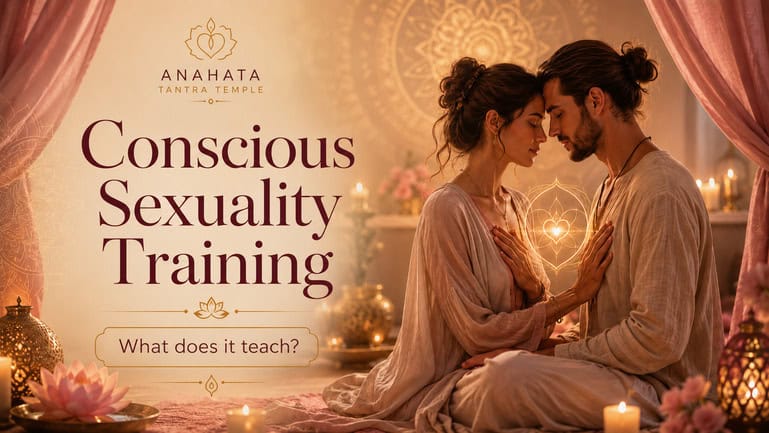

What Is Conscious Sexuality Training?
A well-designed conscious sexuality training does not reduce sexuality to techniques or arousal. Its purpose is to deepen self-understanding—of one’s own body, emotional responses, beliefs, boundaries, needs, and ways of building relationships. This type of education may also include the subject of pleasure, but it does not make pleasure its sole point of reference.
From our perspective, sexuality is a part of human life that involves not only the physical body, but also the mind, relationships, spirituality, and personal dignity. For that reason, training should not function as a spectacle or a collection of tricks. It is more like a process of organizing knowledge and reconnecting with one’s own experience.
In practice, this means exploring questions that prove fundamental for many people. What do I truly feel in my body? How do I recognize consent and non-consent? How do I communicate a need for closeness, and how do I communicate a need for distance? What in my sexuality is genuinely mine, and what has been shaped by cultural, religious, family, or relationship pressures?
What Does Conscious Sexuality Training Teach?
The most important value is not the amount of information, but the quality of awareness. Conscious sexuality training teaches people to recognize that sexuality does not begin with action, but with presence—with the ability to be with oneself without pressure, without performing a role, and without rushing.
A well-designed program usually includes education about anatomy and physiology, presented in a respectful way that helps dispel shame. It also addresses communication: how to talk about one’s boundaries, how to listen to another person, and how to recognize the difference between consent, compliance, and freezing. This is a highly practical area, even if it is not always dramatic. For many people, it is the part that creates the greatest change.
Another element is working with beliefs. Many people grew up without calm, thoughtful sexual education. As a result, they may carry fear, guilt, confusion between intimacy and obligation, or the belief that their bodies should function according to an outside standard. Training can help people recognize these patterns, but it should not promise a miracle. Sometimes it is enough for someone to hear, perhaps for the first time, that they have the right to move at their own pace.
In settings inspired by spirituality, it can also be important to view sexuality as a space of responsibility, respect, and awareness. This does not mean idealizing sex or giving it an artificial sense of grandeur. It means not treating it as either trivial or instrumental.
Who Can Benefit From This Kind of Training?
There is no single profile of a participant. People come alone, in relationships, after a long break from intimacy, or even with what appears to be a “successful” sex life, yet with a sense that something is missing. Sometimes the issue is a lack of language for conversation. Sometimes it is rigidity, shame, or disconnection from the body. Sometimes it is a need to organize one’s knowledge after years of confusion.
Many people come specifically to a tantric massage course for couples, which, in my view, is—contrary to appearances—a valuable form of conscious sexuality training. During tantric massage workshops, participants are not given only knowledge about massage, whether theoretical or practical. A very important part of these workshops is the subject of human sexuality and the couple as a dyad. One of the key topics addressed is boundaries, as well as the Wheel of Consent, which I wrote about in the book Secrets of Personal Development—the only Polish book that received official permission from Dr. Betty Martin to publish the Wheel of Consent in accordance with her guidelines.
At Anahata Tantra Temple, we also meet people who have previously encountered neo-tantric teachings and felt confused. They were unsure what was a developmental practice, what was a ritual, what was education, and what was simply an attractively packaged promise. In such situations, training based on clear definitions and ethics can bring relief. It allows people to return to the basics and regain trust in their own judgment.
For some, it is especially important that they do not have to prove anything. There is no need to be extroverted, “sexually liberated,” or ready to push beyond one’s comfort zone. Good training does not pressure people. It creates conditions for conscious learning.
How Can You Tell Reliable Education From Superficial Content?
This is an area where it is worth maintaining sound judgment. Simply using words like “awareness,” “energy,” or “transformation” does not in itself demonstrate quality. When a training program is good, the facilitator can clearly explain what the program is—and what it is not. They can describe the boundaries, format of the work, safety guidelines, and the purpose of the practices being offered.
Precision of language is also important. In our work, we distinguish traditional Tantra from modern neo-Tantra. Traditional Tantra is a broad family of religious and contemplative paths connected with ritual, philosophy, and spiritual practice, including Buddhist teachings. It is not simply an erotic system. By contrast, some contemporary practices involving the body and awareness developed independently as modern phenomena. This distinction matters because it helps set clear expectations and protects against misuse.
A reliable training program does not create tension through provocation. It does not promise instant awakening, rely on sensationalism, or take advantage of ambiguity around touch or spirituality. Instead, it provides knowledge, context, and time for reflection.
Does This Kind of Training Always Include Body-Based Practices?
Not necessarily. It depends on the program. Some training programs are primarily educational and reflective in nature. Others introduce elements of breathwork, mindfulness, movement, meditation, or simple somatic exercises. The presence of the body in the learning process is valuable, but it does not have to involve intense or boundary-pushing practices.
This is one of the most common misunderstandings about conscious sexuality—the assumption that the more intense the experience, the deeper the transformation. In my view, the opposite is often true. The deepest shifts happen when someone truly hears themselves for the first time and does not have to rush.
What Do Participants Take Away From This Process?
The changes are usually not dramatic, but they can be very real. One woman we worked with through our educational programs said after a series of consultations that, for the first time, she was able to distinguish a desire for closeness from a fear of rejection. It may not sound impressive, but for her it was a breakthrough. She stopped agreeing to intimacy simply to preserve the relationship.
Another person described how the most valuable part was not any new information about sexuality, but the feeling that it was possible to talk about it calmly and without shame. A moment like that can bring many things into order at once—the way someone communicates with a partner, their relationship with their own body, and the level of tension that had previously seemed normal.
There are also participants who come with an interest in spirituality. For them, an important discovery is that sexual awareness is not about intensifying sensations, but about integration: an honest encounter with what is physical, emotional, relational, and meaningful at the same time.
Conscious Sexuality Training and the Responsibility of Facilitators
This topic deserves special emphasis. When working in an area as sensitive as sexuality, the responsibility of the facilitators matters more than the appeal of the program. What matters is how the group is guided, the language that is used, the boundaries that are maintained, the voluntary nature of participation, and the ability to distinguish education from projecting one’s own ideas onto participants.
Professionalism does not exclude warmth. Spirituality does not exclude critical thinking. Likewise, knowledge does not have to feel cold in order to be trustworthy. The most mature training programs bring these qualities together. They make room for the heart without abandoning ethics. They make room for experience without giving up reflection.
So, if you are considering taking this step, do not ask only what you will learn. Also ask what kind of atmosphere you will be learning in, what values the place represents, and whether its message leaves you feeling more calm than pressured. That is a very good compass. Conscious sexuality does not begin with the courage to push beyond yourself, but with the courage to be truly present with yourself.


Leave a comment